
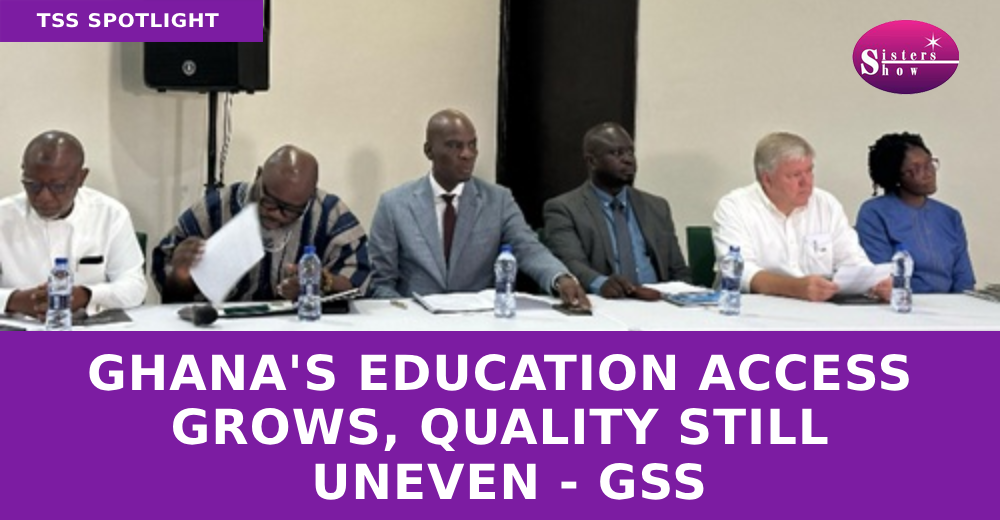
Education Access in Ghana Improves, But Quality Remains a Concern
Access to education in Ghana has made remarkable strides in recent years, but challenges in ensuring consistent quality persist. This is according to the latest report by the Ghana Statistical Service (GSS) and the Ministry of Education. The Access to and Quality of Basic and Secondary Education in Ghana (2000–2023) Report was released on March 25, 2025, and provides a comprehensive analysis of enrolment patterns, teacher availability, and student performance using data from the Education Management Information System (EMIS).
Significant Progress in Enrolment Rates
The report highlights substantial progress in enrolment rates over the last two decades. Between 2001 and 2023, Kindergarten Gross Enrolment Rates (GER) soared from 51% to 122%. Similarly, Primary GER saw an increase from 80% to 90%. Junior High School (JHS) GER improved significantly, rising from 64% to 98%, while Senior High School (SHS) GER showed a notable increase, climbing from 25% to 72%.
Despite these achievements, challenges remain in ensuring age-appropriate enrolment. The report notes that only 66% of children aged 4-5 years are enrolled in kindergarten, while just 47% of children aged 12-14 years attend JHS at the appropriate age. Addressing these gaps remains a critical concern for policymakers and educators.
Gender and Regional Disparities Persist
While gender parity has been achieved at the primary level, disparities continue in performance and access at higher education levels. The report states that in the 2021 West African Senior School Certificate Examination (WASSCE), boys outperformed girls in Mathematics, with pass rates of 70% compared to 60%. Conversely, girls demonstrated higher proficiency in English, achieving a 60% pass rate versus 50% for boys.
Regional disparities in education quality also remain evident. The Northern, North East, and Savannah regions face significant challenges, with pupil-to-trained-teacher ratios exceeding 50:1. In contrast, the Greater Accra region maintains a considerably lower ratio of 25 pupils per trained teacher. These disparities highlight the need for targeted investments in teacher training and educational infrastructure.
Government Commitment to Data-Driven Reforms
At the National Education Forum, where the report was officially launched, Education Minister Haruna Iddrisu stressed the importance of using data to inform policy decisions. He reiterated that the report’s findings would provide valuable insights for shaping the country’s education policies and ensuring equitable access to quality learning opportunities.
“The findings of this report will serve as a guiding tool for policymakers to make data-informed decisions that align with national education goals and address regional disparities,” Iddrisu stated.
The report also assesses Ghana’s progress towards the Education Strategic Plan (ESP) 2018–2030. While Ghana has achieved its targets for gross enrolment and gender parity, net enrolment goals remain unfulfilled across various education levels.
International Support and Recommendations
The report’s launch was attended by Government Statistician Prof. Samuel Kobina Annim, Danish Ambassador Tom Noring, and National Education Forum Chairman Prof. K. T. Oduro. These stakeholders acknowledged the progress made but underscored the need for increased investments in teacher training, school infrastructure, and learning resources to ensure consistent education quality across regions.
Furthermore, the report serves as a crucial monitoring tool for assessing Ghana’s progress towards the Sustainable Development Goals (SDGs) 4 (Quality Education), 5 (Gender Equality), and 10 (Reduced Inequalities).
The Way Forward
To address the challenges highlighted in the report, the government is expected to prioritize policy measures that promote equitable access to quality education. This includes strengthening teacher training programs, expanding school facilities, and improving resource allocation in underserved regions. Stakeholders also call for stronger community engagement and public-private partnerships to further enhance educational outcomes.
For more updates on developments across the continent, stay tuned to african news platforms, providing comprehensive coverage on education and other key sectors.
Don’t miss out on the latest updates. Stay updated with Spotlights with The Sisters Show. Get all the details and never miss a beat!